
Contents
Empowering Your Workforce with No-Code Process Checklists
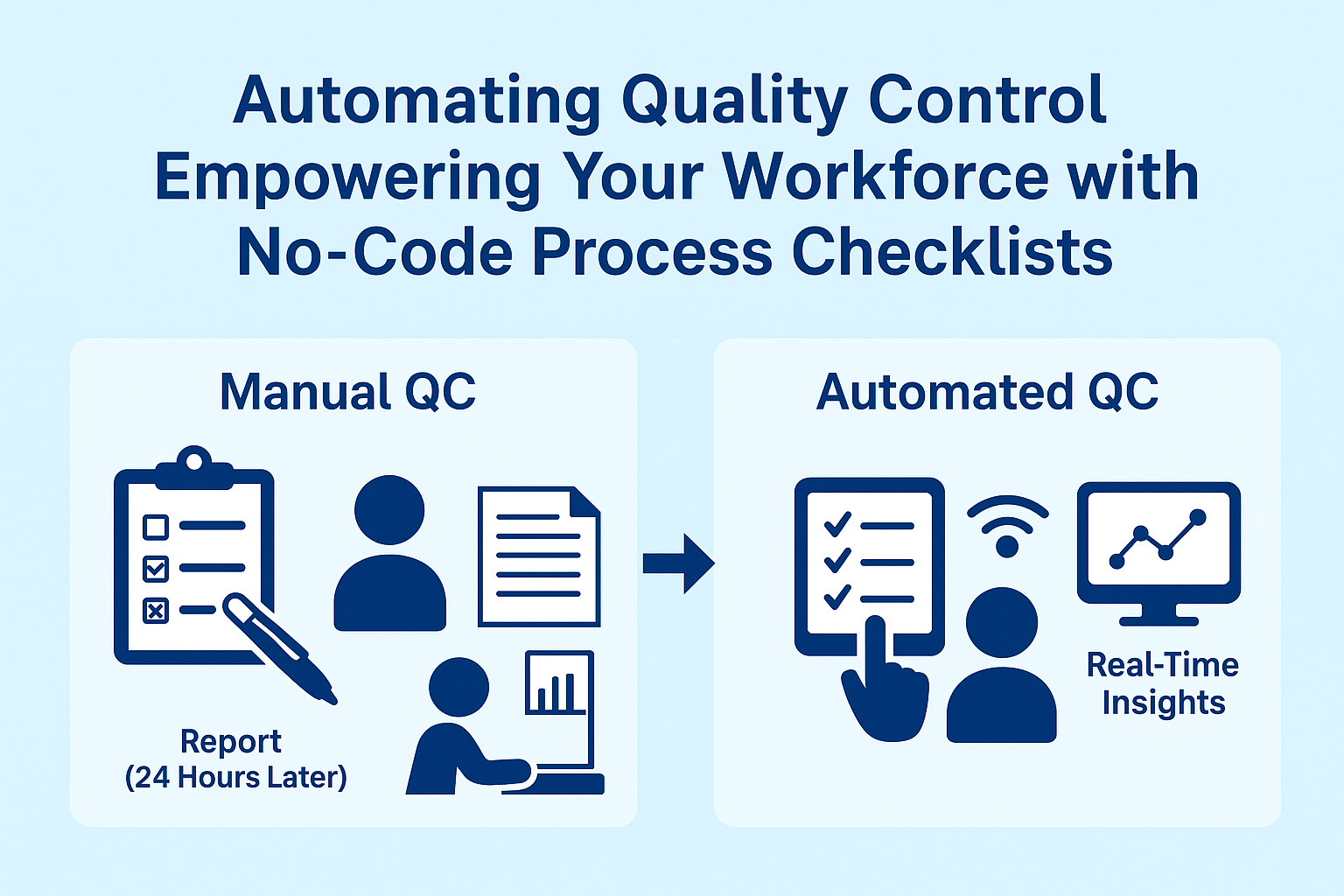
The clipboard and pen. For decades, it’s been the symbol of quality control on the manufacturing floor. But it’s also a symbol of everything that’s slow, unreliable, and disconnected about traditional QC processes.
Your quality inspectors are diligent, but they are working with a broken tool. Paper checklists get lost, handwriting can be illegible, and “pencil-whipping” – signing off on a check without actually performing it is a constant risk. The data, when it’s finally entered into a spreadsheet, is hours or even days old, making it impossible to spot and react to production issues in real time.
This isn’t just inefficient; it’s a direct threat to your quality standards, your compliance record, and your bottom line.
The True Cost of a Paper-Based Process
Relying on manual checklists in a digital-first world creates significant business risks that go far beyond simple inconvenience.
- Failed Audits & Compliance Gaps: A missing form or an incomplete checklist can result in a failed audit, putting certifications and customer contracts at risk. There is no reliable, automated audit trail.
- Increased Scrap & Rework: By the time a quality issue is discovered through manual data entry, you may have already produced thousands of non-conforming parts, leading to costly scrap or rework.
- Lack of Visibility: Plant managers have no real-time insight into quality trends. You can’t manage what you can’t measure, at least not until it’s too late.
- Inefficient Workforce: Your most experienced quality professionals spend their time chasing paperwork and manually compiling reports instead of focusing on process improvement.
As we detailed in our guide, Guide to Driving User Adoption on the Shop Floor, the failure to provide modern, effective tools is a primary barrier to achieving operational excellence.
The Solution: Empower Your Experts with No-Code Tools
What if your quality supervisors – the people who know your processes inside and out, could build their own digital, interactive checklists without writing a single line of code?
This is the power of a no-code automation platform. Instead of relying on IT to develop a custom application, you empower your operational team to digitize their own workflows. A low-code/no-code platform provides simple, drag-and-drop tools to turn any paper form into a powerful digital process.
With Anakage, you can create dynamic checklists that:
- Enforce Compliance: Make critical steps mandatory, ensuring no check is ever skipped.
- Capture Rich Data: Go beyond a simple checkmark. Capture photos of defects, record precise measurements, and add notes directly from a tablet on the shop floor.
- Provide Real-Time Guidance: Embed work instructions, diagrams, or videos directly into the checklist to guide the inspector through complex procedures.
- Create an Instant Audit Trail: Every action is automatically timestamped and logged, creating a perfect, unchangeable record for compliance and audits.
Proof Point: Eliminating Errors Through Live Validation
The core principle here is ensuring a process is followed correctly, every single time. This is a challenge we solved for a leading German automotive manufacturer who was struggling with high error rates in their invoicing application.
By implementing Anakage’s live, on-screen validation and suggestions, they guided users to enter the correct information at the moment of action. The result was transformative: they completely eliminated usage errors and reduced employee onboarding time by 75%.
This same technology can be applied to your quality checklists, validating measurements in real-time and preventing an out-of-spec recording before it’s even submitted.
From Data Entry to Data-Driven Decisions
When your quality data flows from the shop floor to a central dashboard in real time, you transform your entire operation. You move from reactive problem-solving to proactive process improvement. Your managers can spot a negative trend in minutes, not days, allowing them to intervene before a minor issue becomes a major quality failure.
By empowering your workforce with the tools to build their own digital solutions, you create a culture of ownership and continuous improvement, driving quality and efficiency from the ground up.
Ready to tear up your paper checklists for good?
Schedule a 15-minute demo to see how you can build a no-code quality control workflow in just a few hours.
Have you read about our last release? Click here to read!
Frequently Asked Questions (FAQ)
- Q: What are the main problems with paper-based quality control?
A: Paper checklists are slow, lead to illegible data, get lost, and can be “pencil-whipped” (signed off without checking). This causes delayed insights, compliance gaps, and an increase in costly scrap and rework. - Q: What is a no-code quality control checklist?
A: A no-code checklist is a digital form built using a platform that requires no programming. It allows quality experts to create interactive checklists for tablets that can include mandatory fields, photo capture, and real-time guidance. - Q: How does a no-code platform improve manufacturing quality?
A: It provides real-time data visibility to managers, allowing them to spot negative trends in minutes. It also enforces compliance by making key steps mandatory and creates an instant, unchangeable digital audit trail. - Q: Can a digital checklist capture more than a checkmark?
A: Yes. Unlike paper, digital checklists can capture photos of defects, precise measurements, user signatures, and timestamped notes, providing much richer data for analysis and compliance.